Salt Spring Island, BC

Baker Beach
Shoreline Project

A responsible, science-backed approach to protecting our coastline, designed to work with nature, informed by community feedback, and built for long-term resilience.

Why This Project Is Needed

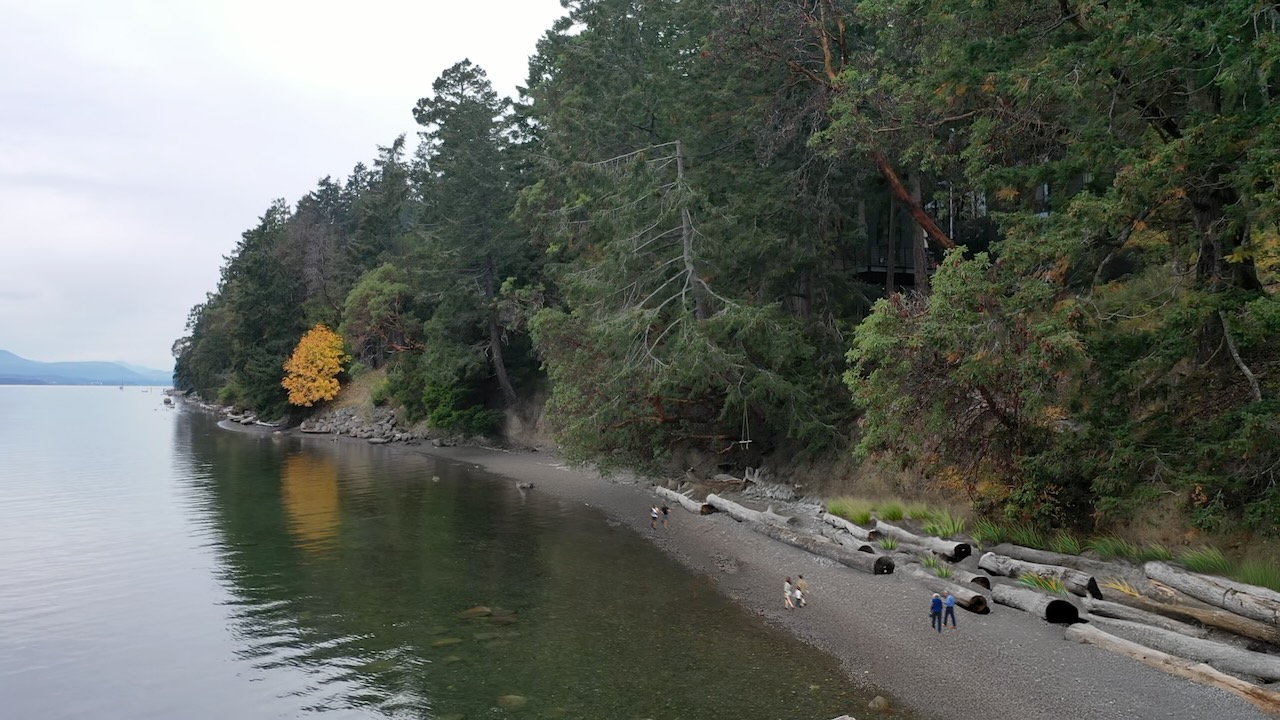
Baker Beach is losing ground, literally. Intensifying king tides and winter storms driven by climate change have dramatically accelerated erosion along the shoreline. The slope is retreating, mature trees that stabilize the hillside and shelter eagles and bats are being undermined, and the sediment that sustains nearshore habitat is washing away.

The erosion is already severe enough that the Capital Regional District reinforced both main beach access points with rock walls to keep them safe. But the adjacent shoreline remains unprotected, and geotechnical experts warn that once toe support is lost and the slope begins to retreat, the damage becomes difficult or impossible to reverse.

This is not a future risk. It is happening now. Acting early with a responsible, nature-based approach is both more effective and more environmentally sound than waiting for a crisis and resorting to emergency hard armouring after it's too late.
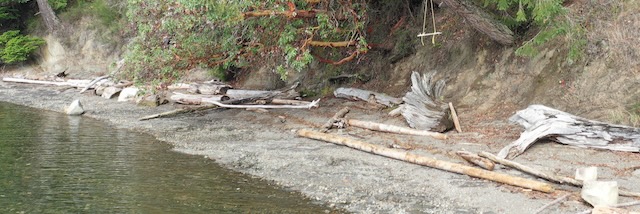
Erosion damage at Baker Beach shoreline

Active erosion at Baker Beach

A New Approach, Informed by Community Feedback

After listening to community concerns about the scope of the original multi-property green shoring proposal, we've submitted a focused, single-property application for a hybrid naturalized rock revetment, a smaller-scale solution designed by professional geotechnical engineers and evaluated by qualified environmental professionals.

Why this proposal is different

The most common concern raised during public consultation was that the original proposal involved "too much material" being added to the beach. We heard that feedback. This new design is a single-property solution that directly addresses the scale concern while still providing effective, long-term shoreline protection. It represents the best path forward: a science-based compromise that respects both the environment and the community.

🌱

Nature-Based Design

Uses a naturalized rock revetment with bioengineering elements including soil wraps, live-stake willows, and native plantings, designed to blend with the existing shoreline rather than fight it.

🌊

Single-Property Scope

Scaled down from the original multi-property application to address a single lot, significantly reducing the overall footprint and volume of material involved.

🛡️

Geotechnically Sound

Designed by Ryzuk Geotechnical with a gabion basket and rock wall structure, engineered for long-term slope stability and minimum environmental disturbance.

🏡

Preserves What Matters

Protects mature trees critical for slope stability, eagle and bat habitat, and the natural beauty of the shoreline that all Salt Spring residents value.

How It Works

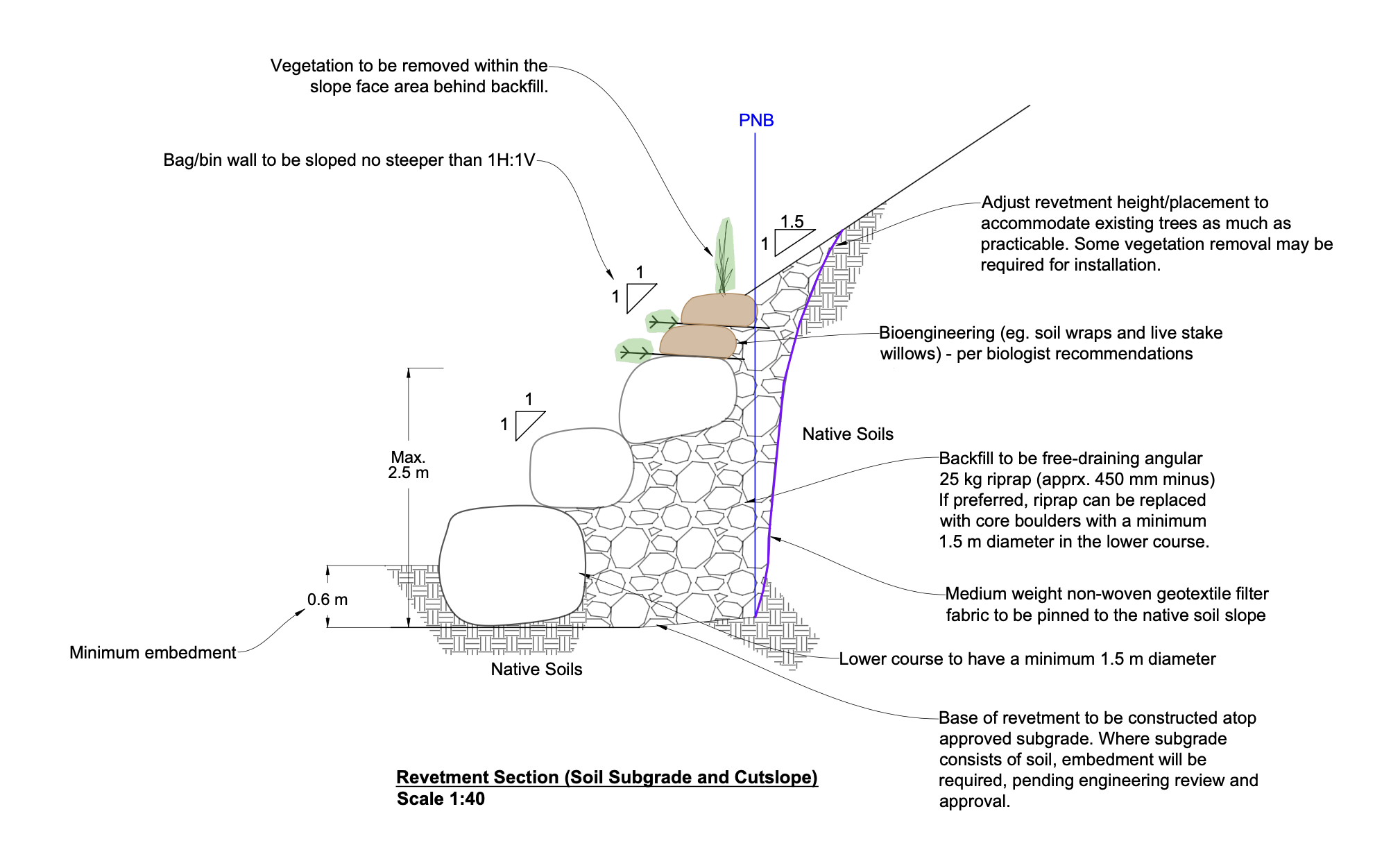
The hybrid revetment is designed to stabilize the toe of the slope using natural rock and bioengineering techniques, preventing further erosion while enhancing ecological function.

Cross-section diagram of the hybrid naturalized rock revetment design showing gabion baskets, native soils, geotextile fabric, and bioengineering elements

Revetment section (soil subgrade and cutslope), Scale 1:40. Designed by Ryzuk Geotechnical.

Rock Revetment

Lower courses use a minimum 1.5m diameter rock base. Gabion baskets are sloped no steeper than 1H:1V and backfilled with free-draining angular material.

Bioengineering

Soil wraps and live-stake willows (per biologist recommendations) stabilize the upper slope, promote root reinforcement, and create natural habitat as they mature.

Tree Preservation

Wall height and placement are adjusted to accommodate existing trees as much as practicable, protecting the root systems critical for ongoing slope stability.

Environmental Safeguards

Geotextile filter fabric pinned to native soil slope prevents sediment migration. All work supervised by an Environmental Monitor and timed to fisheries windows.

Designed to Protect Marine & Terrestrial Habitat

Every aspect of this project has been evaluated by qualified environmental professionals (Corvidae Environmental Ltd.) to ensure it protects the sensitive ecosystems of Baker Beach.

The environmental assessment confirms that with the recommended mitigation measures, the project will result in no net loss of productive fish habitat capacity and no significant residual effects on the marine environment.

Key protections include construction during low tide (work in the dry), professional environmental monitoring during all works, avoidance of eelgrass beds and forage fish spawning habitat, and native species planting to enhance backshore vegetation.

The project has received its Heritage Conservation Act permit (issued November 2024) and follows all DFO guidance for avoiding prohibited effects to fish and fish habitat.

Part Two

Our Journey So Far

Baker Beach has seen alarming shoreline erosion in recent years. What started as a collaborative effort among neighbours to protect this shared coastline has evolved through regulatory processes, public debate, and a judicial review. Here's what happened, and why we're still working toward a solution.

The Story of Baker Beach

Baker Beach has seen a noticeable increase in shoreline erosion in recent years, driven by stronger king tides and winter storms linked to climate change. The erosion is reshaping the shoreline, affecting wildlife habitat, public access, and nearby properties. The impacts have been significant enough that the Capital Regional District (CRD) reinforced the two main beach access points from Quarry Road and Baker Road with rock walls to maintain safe access.

To help mitigate further erosion, a group of neighbouring property owners (originally four, then three) chose to work collaboratively on a shared nature-based shoreline protection approach, a "green shoring" proposal that was consistent with provincial best practices and supported by both the Province and Fisheries and Oceans Canada.

Despite this professional, evidence-based approach, the proposal met significant public opposition, much of it based on misinformation spread through social media, a petition, and local media. The Islands Trust Local Trust Committee (LTC) ultimately rejected the development permit application, and a judicial review at the BC Supreme Court upheld that decision.

The core irony, as noted in the Gulf Islands Driftwood, is that professionally designed, peer-reviewed solutions, supported by the very agencies responsible for environmental protection, were treated as unacceptable. The shoreline continues to erode, and the need for action has not gone away. That is why we have submitted this new, scaled-down proposal.

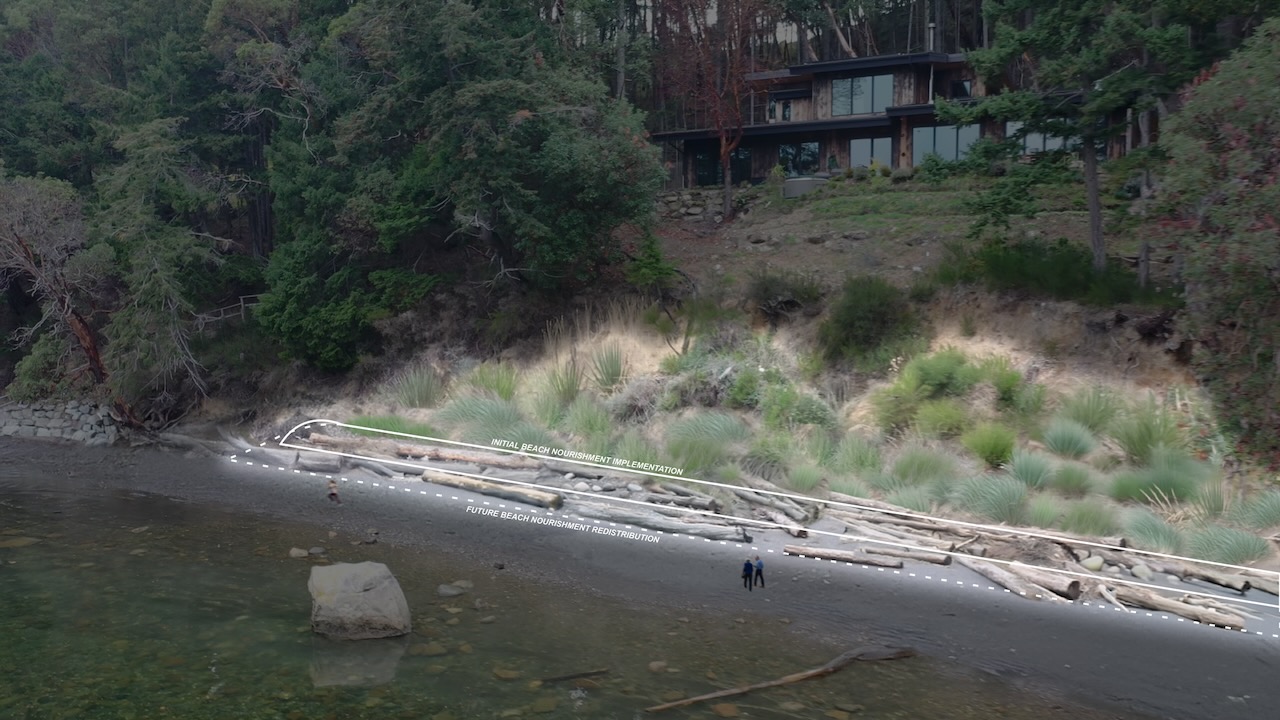
Before and after rendering of Baker Beach shoreline restoration Before and after rendering of Baker Beach shoreline restoration

Renderings from the original nature-based shoreline protection proposal

Media Coverage

Community Concerns & The Facts

Many concerns were raised during the public comment period. We take all feedback seriously. Below are the most common concerns and the factual responses, supported by professional assessments and the public record.

1

"Too much material / fill will be added to the beach"

Addressed in New Proposal

This was the most frequently raised concern, and we heard it clearly. The original multi-property proposal involved beach nourishment across a larger area. The new proposal is a single-property hybrid rock revetment that significantly reduces the scale and volume of material. The design uses targeted rock placement and bioengineering rather than broad beach nourishment. This is precisely why we changed our approach: to directly address this concern while still protecting the shoreline.

2

"The public was not properly informed or consulted"

Not Supported by the Record

The original application was a staff-level decision under Islands Trust policy, not a Local Trust Committee decision - meaning it did not require a public hearing. The correct process was followed. Public consultation occurred through the provincial Crown Land application process, which is the standard mechanism for community input on foreshore projects. Additionally, the website bakerbeach.ca was created specifically to inform the public and answer questions, going above and beyond what was required.

3

"First Nations were not consulted"

Not Supported by the Record

This is categorically false. We've engaged extensively with Indigenous communities throughout the entire project. We reached out to 13 First Nations communities with hereditary rights in the area. Engagement with the Penelakut Tribe began in August 2022, more than two years before the permit was issued, and has been continuous, including phone calls, letters, video conferences, in-person site meetings, and participation in a Penelakut potluck at Baker Beach. We have also engaged with the Tsawout First Nation, including site visits. A Heritage Conservation Act Permit was issued in November 2024 following full compliance with consultation requirements. See the full timeline below.

4

"This will damage eelgrass beds and spawning habitat"

Not Supported by Evidence

A diver was hired to collect sediment samples around the eelgrass beds, demonstrating that gravels from the slopes are not migrating to eelgrass areas. The environmental assessment by Corvidae Environmental confirms no net loss of productive fish habitat capacity with the recommended mitigation measures. All work will be done during low tide, overseen by an Environmental Monitor, and timed to avoid forage fish spawning periods. DFO provided a letter of advice confirming measures to avoid and mitigate potential effects to fish and fish habitat.

5

"This will restrict public beach access"

Not Supported by the Record

Absolutely not. The beach has always been and will always remain fully accessible to the public. The project works on the slope and immediate foreshore. It does not block, impede, or alter any beach access paths. The CRD's own reinforcement of beach access points with rock walls demonstrates that some structural intervention is already normal and accepted for this beach.

6

"There is no urgency. The erosion is not that serious"

Not Supported by Evidence

Professional geotechnical assessment confirms ongoing, incremental erosion that presents a foreseeable risk to slope integrity over time. The geotechnical experts note that loss of toe support and progressive slope retreat are difficult or impossible to reverse once they occur. Early intervention using nature-based methods is considered more environmentally responsible and cost-effective than reactive hard armouring after significant degradation. The mature trees on the slope, home to eagles and bats, are directly threatened by continued erosion.

7

"This is just for the benefit of private property owners"

Misleading

While property protection is one element, the project's primary objectives include protecting marine and riparian habitat, preserving mature trees that support wildlife (eagles, bats), stabilizing the slope to prevent uncontrolled sediment delivery to the nearshore environment, and enhancing native vegetation. Doing nothing risks losing not only land and structures but also critical habitat, something anyone who walks Baker Beach can see is worth protecting. The CRD itself has already intervened with rock walls to protect public access infrastructure.

First Nations Consultation Timeline

We are committed to meaningful, ongoing engagement with Indigenous communities. This timeline documents our consultation efforts, which began in 2022 and continue to this day.

August 5, 2022
Initial outreach to Penelakut Tribe via project coordinator
August 16, 2022
Phone call and voicemail to Josh James, Penelakut Tribe
October 2022
Letter outreach to First Nations communities
September 2023
Heritage Conservation Act (HCA) application referral submitted
March 8, 2024
Penelakut project update via letter and email
September 13, 2024
Update from WLRS regarding Tsawout First Nation involvement requirements
November 7, 2024
Heritage Conservation Act Permit issued
November 14, 2024
Update from WLRS regarding Penelakut questions
December 16, 2024
Video call between Penelakut and project technical team
December 20, 2024
Updated guidance from WLRS regarding Penelakut questions
February 12, 2025
Site meeting with Tsawout First Nation at Baker Beach
March 7, 2025
Update to Penelakut regarding WLRS directives
May 14, 2025
Participation in Penelakut potluck at Baker Beach
June 25, 2025
Update to Penelakut regarding results from diver and geo assessment of aggregates collected